AI-proof careers are not a list to copy blindly
Lists of AI-proof jobs can feel comforting, but they often hide the real decision. You need a path that is resilient and also fits your strengths, constraints, and proof.
What this page helps you decide
- Which safer work patterns fit me?
- What proof would make this path believable?
- How can I test the direction before switching?
AI career risk is easier to judge at the task level than from headlines. Use this page to see what to adapt, strengthen, or stop worrying about.
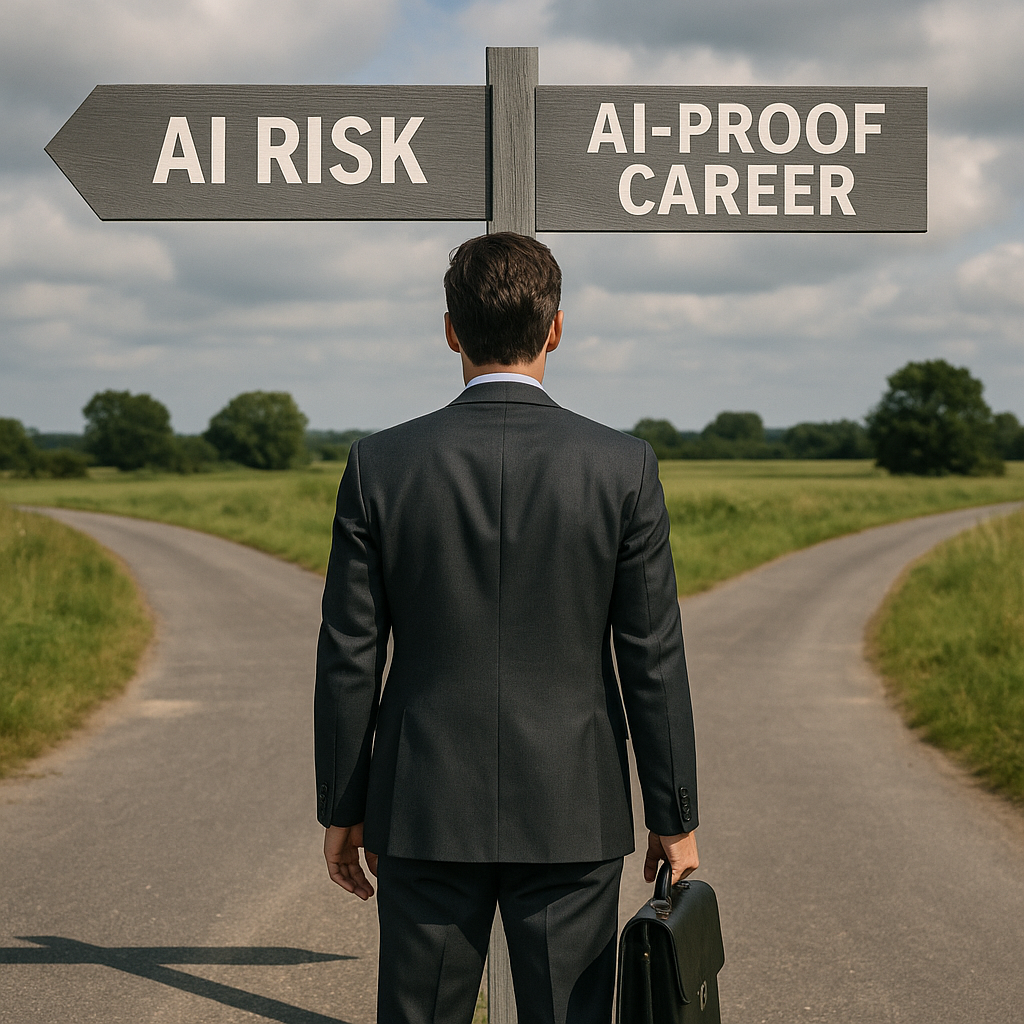
Let's name the fear honestly: "Will AI kill my job?"
The truth is subtler: AI won't erase all jobs, but it will reshape almost every job. Some roles are clearly at risk; others get more valuable because of AI, not less.
This guide is for you if you keep seeing headlines about "AI replacing humans" and secretly wonder if your career has an expiry date. We'll talk about which careers are safe from AI, which are most exposed, and how to AI-proof the path you're already on, without panic-switching into a random new field.
Fast track - check if your career is at risk
- Pick your current role or closest match.
- Answer a few questions about your daily tasks.
- See your exposure level + nearby AI-proof paths.
You can do this in a few minutes with our Examine my career decision inside the free first read.
= Reframe: Instead of asking "Will AI replace me?", ask "What would my role look like with AI as my co-worker?"
Why we exist: we want your career to feel calmer and more future-ready, not more chaotic. WisGrowth helps you see your risk clearly, then design experiments that move you toward AI-resilient work.
Below, we'll walk through how AI actually changes work (without jargon), which careers are most exposed, which are relatively safe, and the practical moves you can make this month to future-proof your path.
How AI Actually Changes Work (Without the Hype)
Most conversations about AI jump straight to extremes: "robots will do everything" vs "nothing really changes." The reality is more boring and more useful: AI automates tasks, not entire humans.
Any job is a bundle of tasks. Some of those tasks are:
- Repetitive and predictable: copy-pasting data, answering the same customer query, reformatting documents.
- Pattern-based but flexible: writing emails, drafting content, summarising meetings.
- Deeply human and contextual: resolving conflicts, coaching a team member, reading a room in a negotiation.
AI is already strong at the first category, rapidly improving at the second, and still clumsy at the third. What careers are safe from AI? The ones where the third category-context, judgment, relationships, and stakes-takes up a lot of your actual day.
Careers Most Exposed to AI (By Task, Not Job Title)
Instead of memorising a scary list of job titles, look at clusters of work where AI is already very good.
1. Repetitive knowledge work
These are roles where most of the day is spent moving information from one place to another with clear rules. Examples include:
- Basic data entry and form processing.
- Standardised back-office processing (claims, simple approvals).
- Highly templated reporting with low judgment.
AI tools can already handle these workflows faster and at lower cost. Here, entire roles are at genuine risk if they don't expand into oversight, exception handling, or process design.
2. Basic content production
When people ask, "Which careers will AI replace?", generic content creation is near the top of the list:
- Mass SEO articles with no real opinion or expertise.
- Simple ad copy with rigid templates.
- Routine internal comms that follow a fixed pattern.
AI can now draft first versions in seconds. What remains valuable is voice, originality, and strategy-not just word count.
3. Scripted customer support
Chatbots and AI assistants are getting good at handling FAQs, simple queries, and order updates. Roles that only read scripts are exposed. But:
- Escalation support for complex, emotional, or high-stakes issues.
- Customer success roles that build relationships and retain key accounts.
&can become more important as the "easy tickets" get automated away.
Careers That Are More AI-Resistant (For Now)
No job is completely AI-proof, but some are much harder to automate end-to-end. When you ask, "Which careers are AI proof?", look for roles where humans are the product.
1. Human-heavy roles: emotions, trust, and nuance
These careers lean heavily on empathy, trust, and the ability to hold complex human stories:
- Therapists, counsellors, and coaches.
- Leaders and managers who actually develop their teams.
- Negotiators, mediators, and people in conflict resolution.
- Caregiving roles where safety and emotional presence matter.
AI can assist with notes and suggestions, but people don't want to be comforted or led by a script.
2. Deep domain roles with real-world context
Some careers depend on a thick stack of context: regulations, edge cases, history, and real-world constraints. Examples:
- Specialist doctors and allied health professionals.
- Complex B2B solution architects.
- Lawyers in nuanced domains and strategic advisors.
- Risk, safety, and compliance experts in high-stakes industries.
AI can help surface options, but the responsibility for choosing correctly sits with humans who understand consequences beyond the spreadsheet.
3. Hybrid "tech + human" roles
Some of the most AI-proof jobs are those that help organisations use AI well:
- AI product managers and owners.
- Change managers guiding teams through AI adoption.
- Educators designing learning experiences using AI tools.
- Analysts who turn AI outputs into business decisions.
These roles aren't fighting AI-they are shaping where and how it's applied.
How to "AI-Proof" the Career You Already Have
Here's the good news: you don't need to become a machine learning engineer to stay relevant. You do need to adjust how you work.
1. Treat AI as a co-pilot, not a competitor
Start by asking: "Which 20-30% of my tasks are repetitive or templated?" Then:
- Use AI to draft, summarise, or brainstorm first versions.
- Keep human judgment for editing, prioritising, and deciding.
- Document what you learn so you can show employers you work with AI, not around it.
2. Shift from pure execution to decision and design
As execution becomes more automated, value moves toward:
- Designing workflows: deciding which tools to use, when, and why.
- Setting priorities: choosing which problems matter most.
- Translating between worlds: business tech, users teams.
Ask yourself: "If AI did 30% of my execution, how could I use that freed-up time to decide better instead of just doing more?"
3. Build proof: side projects, portfolio, mini-experiments
When people ask, "How do I future-proof my career?" the answer is not another certificate. It's proof:
- A small project where you redesigned a process with AI.
- A portfolio that shows how you solved a real problem end-to-end.
- Mini-experiments where you tested a new role direction for 2-4 weeks.
WisGrowth's focused evidence test concept is built exactly for this: focused evidence tests that generate real evidence you can show to hiring managers.
Turn Insight into Your Personal AI-Proof Plan
Reading about "AI proof jobs" is useful. But the real shift happens when you connect the dots back to your life: your role, your fit signal, your constraints.
That's where WisGrowth comes in. We're not here to shout \"learn to code or else\" at you. We're here to:
- Map how much of your current work is actually AI-exposed.
- Highlight role families that fit your strengths and are more AI-resilient.
- Suggest 1-2 simple experiments you can run in the next 7 days.
Next steps - 20 minutes to a calmer plan
- Take the Career Decision first read and mark your concern about AI explicitly.
- Review the role families and risk level WisGrowth surfaces for you.
- Pick one nearby AI-resistant path and design a mini-experiment around it.
- Repeat for 2-3 weeks, then decide if you need mentorship, coaching, or a deeper pivot.
AI isn't a wave you can stop, but you can absolutely learn to surf it on your own terms instead of being knocked over by it.
FAQs
AI is much more likely to change your job than completely replace it. Roles made of highly repetitive, predictable tasks are most exposed.
- Jobs that blend human judgment, context, empathy, and cross-functional collaboration are far more resilient, especially when you learn to use AI as a co-pilot.
No career is 100% AI-proof, but some are more AI-resistant. These include human-heavy fields like therapy, coaching, leadership, negotiations, and caregiving; deep domain roles where context and nuance matter; and hybrid jobs that combine technology with people skills, such as AI product owners, solution consultants, and educators who design learning experiences.
The most exposed jobs are those built around repetitive knowledge work and basic content production: simple data entry, rote customer support, formulaic copywriting, basic reporting, and templated back-office tasks.
- Even in these areas, tasks are being automated before entire roles disappear, which is why upskilling into oversight and decision-making is key.
To future-proof your career, learn how to use AI tools as co-pilots, move gradually from pure execution to decision and design work, build a visible portfolio of projects, and keep deepening the domain knowledge and people skills that AI can't easily replicate.
- Small, consistent experiments matter more than one big pivot.
You don't need to panic-switch careers just because of AI. First, understand how exposed your current role is, then identify nearby paths where your skills still matter but the work is more AI-resistant.
- In many cases, upgrading your role inside your existing field towards strategy, product, or problem-solving is safer than a total reset.
Ready to see how AI-safe your career really is?
Take a quick clarity + AI-exposure check, then get one focused evidence test to start future-proofing your path this week.
Examine my career decisionClear next step
- Use the page to name the decision, not just collect more advice.
- Look for the missing evidence that would make the next move safer.
- Take one small action now, then review what changed.
What to do next
- List the tasks in your current or target role that AI changes most.
- Pick one adjacent strength you can deepen this week.
- Build a small proof asset so the conversation moves from fear to evidence.
Sources and references
Sources checked 24 August 2026.
Grounded in real-world career data
WisGrowth references occupation, skill, education, and labour-market data from trusted public sources where available, then connects those signals to your current proof and next move.
- Looks at tasks, skills, proof, and adaptability instead of job-title panic.
- Keeps recommendations realistic, current, and evidence-aware.
- Shows when a signal is incomplete instead of pretending every answer is certain.