Proof of Work for Careers: Why Evidence Beats Claims
Resumes describe. Proof convinces.
For builders, creators, career switchers, and anyone who wants a hiring advantage that is hard to fake.
Small starting point: Pick one role you want. Write one "work sample" you could ship in 7 days.
Claims vs evidence
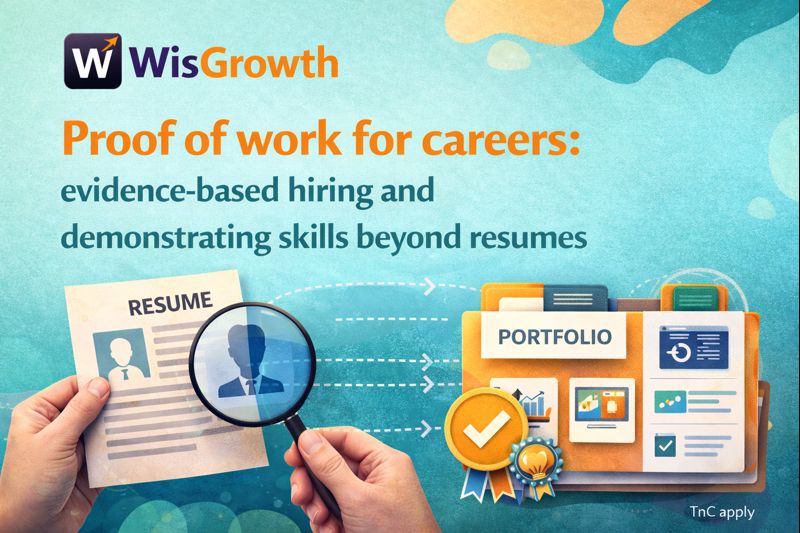
The job market is full of claims. "Hardworking." "Strategic." "Fast learner." "Results-driven." None of these are wrong. They are just weak.
Proof changes the conversation. Instead of asking someone to believe you, you show what you did, how you thought, and what changed.
This is why proof of work is becoming the real currency of hiring, especially in global and remote roles.
Why resumes alone fail
Resumes are necessary, but they struggle in modern hiring. Not because the format is bad, but because the context has changed.
- Global competition: you are not competing locally anymore. You are competing with people who present evidence clearly.
- Fast filtering: recruiters skim. ATS parses. Anything vague gets filtered or ignored.
- Credential inflation: degrees and certificates are common. Proof is rarer.
- Career switching: your resume may not "look" like the role yet, even if you could do it well.
The resume is still important. But today, it works best as the summary of your evidence, not the replacement for it.
If you want a clear ATS baseline, read ATS Resume Explained and run a scan on Resume Scanner.
What proof of work means in careers
Most people hear "proof of work" and think "portfolio." That's part of it, but the real definition is broader.
It is not just portfolios
Portfolios are one format. Proof can also be a case study, a playbook, a decision memo, a teardown, a process improvement, a report, or even a reflection that shows strong thinking.
It is not just credentials
Credentials say you completed something. Proof shows you can use it. Hiring managers trust work outputs more than certificates.
It is evidence of thinking and execution
Proof is the combination of: your decisions, your structure, your trade-offs, and what you delivered. It answers: "Can this person do the work here?"
It is repeatable
One work sample helps. A system that creates proof regularly is a moat. That is when your career starts compounding.
Proof is not about showing off. It is about reducing uncertainty for the person hiring you.
Examples of career proof
Proof comes in different shapes. The best proof is small, specific, and easy to understand.
1) Experiments
A structured test that produces evidence quickly. You can do this while working full-time. If you want the framework, start with Career Experiments.
2) Projects
A project becomes proof when you explain the why, the trade-offs, and the outcome. A half-finished "project list" is not proof. A single shipped work sample is.
3) Outcomes
Outcomes are what recruiters love because they are hard to fake. Revenue impacted, costs reduced, time saved, churn decreased, conversion improved, cycle time cut. Outcomes make your resume clean.
4) Reflections
Reflection is underrated proof. A short "what I learned, what I would do differently, and why" shows maturity. It also makes interviews easier because you already know your story.
How WisGrowth makes proof systematic
Most people do proof by accident. WisGrowth turns it into a system.
- Experiments: small, structured tests you can finish.
- work samples: you save what you shipped, plus the context that makes it credible.
- Resume alignment: you translate proof into role language so ATS and recruiters can read it fast.
You can start from direction using Career Decision first read or start from your resume using Resume Scanner.
Switching careers without quitting? This is how you do it safely: Career Change Without Quitting Your Job.
Why proof reduces anxiety
Career anxiety often comes from one problem: you are trying to decide with no evidence.
Proof reduces anxiety in two ways:
- Psychological: you stop relying on hope. You start relying on what you can show.
- Practical: your resume improves, your interviews improve, your confidence improves.
Even if you do not switch careers, proof makes you stronger in your current one. Evidence travels.
Start building career proof safely
Pick a direction. Run one focused evidence test. Save one work sample. That is how careers become clearer and stronger.
Get a free first readWant to begin with ATS? Use Resume Scanner.
FAQs
Proof of work in a career is evidence that you can do the job, not just talk about it. It can include outcomes you shipped, problems you solved, case studies, process documents, experiments, reflections, and work samples that show thinking and execution.
- It is broader than a portfolio and more credible than credentials alone.
Proof is not a replacement for experience, but it makes experience visible and believable. Experience without clear evidence can read vague.
- Proof turns experience into signal.
- For career switchers, proof can bridge the gap when direct experience is limited.
Yes. Non-tech roles can show proof through written case studies, decision documents, process improvements, before-and-after metrics, customer insights, training plans, audits, playbooks, presentations, and results from focused evidence tests.
- Proof is about work output and impact, not code.
Proof helps ATS and recruiters because it makes alignment clear. When proof is translated into resume bullets using role language and measurable outcomes, it improves the signals ATS indexes and the credibility humans see.
- Proof also makes your story consistent across resume, LinkedIn, and interviews.
Why evidence beats claims in hiring
This blog page owns the educational intent: why proof of work matters and why resumes alone often fail. For a step-by-step asset builder, use the proof of work career assets guide.
- Claims ask employers to believe you.
- Evidence lets them inspect how you think and execute.
- The strongest proof is small, relevant, and easy to skim.
Sources and references
Sources checked 24 August 2026.
Clear next step
- Use the page to name the decision, not just collect more advice.
- Look for the missing evidence that would make the next move safer.
- Take one small action now, then review what changed.
Built on more than a quiz
WisGrowth studies where you are now, where you want to go, what proof you already have, and what evidence is missing before suggesting a next move.
- Combines decision context, strengths, skills, interests, constraints, and missing evidence.
- Uses career-stage patterns and real-world occupation or skill data where available.
- Helps you decide what to test, what to build, and what to avoid rushing into.