focused evidence test → One Week to Show Real Value
Hiring managers don't fall in love with responsibilities - they trust proof. This is a simple informational plan: in 7 days, you'll create one small, skimmable work sample that shows what you improved and how you think.
What you'll have in 7 days
- One clear outcome to showcase.
- One tidy work sample (mini case study / process improvement / demo).
- One resume-ready version (2-3 outcome bullets).
- One outreach message that points to your proof.
Optional tools (if you want them): Examine my career decision and Resume Scanner.
Let's turn "I did a lot" into "Here's exactly what I did and what it achieved."
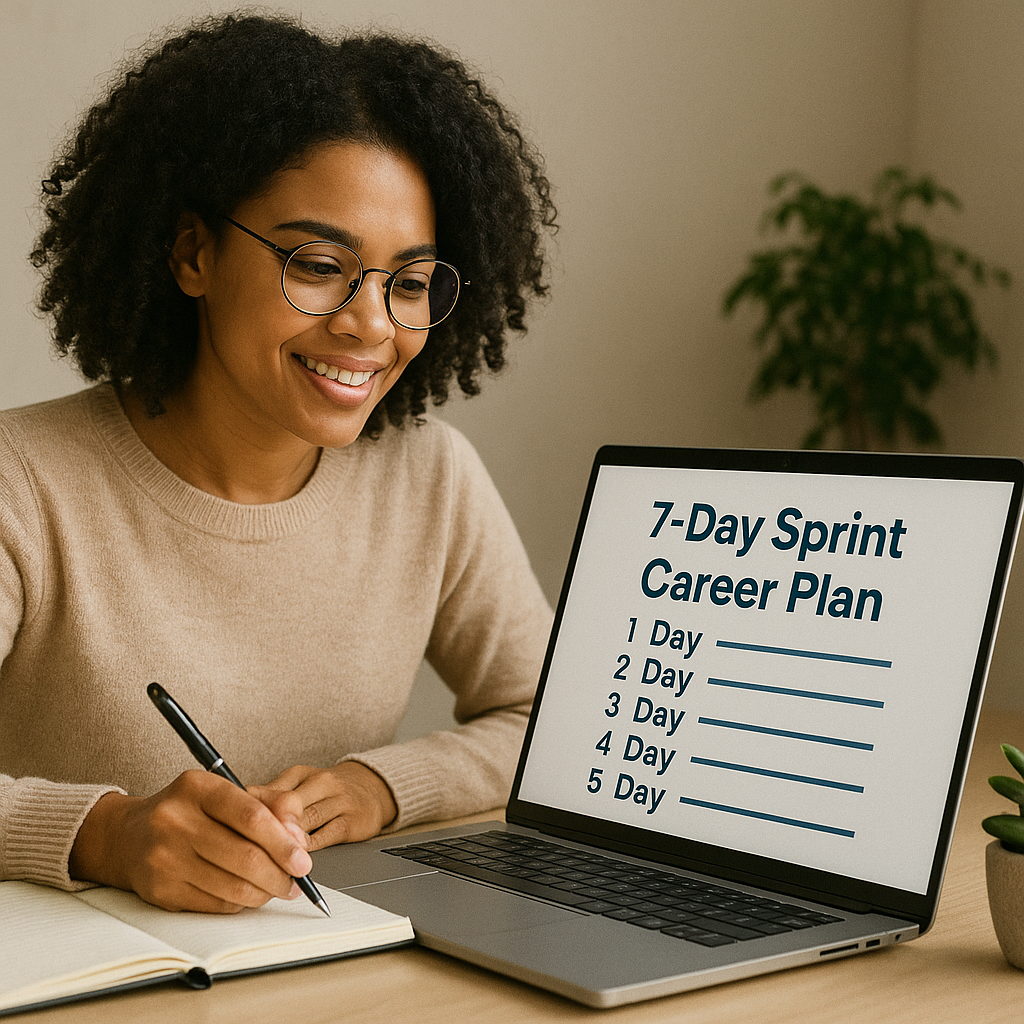
How to Build Proof for Your Career in 7 Days
This sprint is a finishable path to turn your work into a mini case study recruiters can skim. It's not "build a huge portfolio." It's one small, believable work sample that proves you can create value.
Why a proof sprint works
Most careers have invisible work: decisions, fixes, coordination, process improvements. Proof makes your work legible. When you can show proof, you can:
- Use it in interviews ("Here's a real example.")
- Reference it in outreach ("I built X and improved Y.")
- Translate it into resume bullets that feel believable.
- Stand out from generic "responsible for&" resumes.
7-day plan (do this exactly)
If you're unsure what direction to aim for, start by choosing one role family you're exploring. Keep it practical: one direction for one week. If you want help narrowing that direction, use the Career Decision first read.
Day 1 - Pick the win
Choose one outcome you can talk about: reduced time, fewer errors, improved process, solved issue, simplified onboarding, increased conversion, lowered cost, improved quality. If you can't find one, take a current task and make a 10-20% improvement this week.
Day 2 - Gather raw material
Collect evidence: emails, dashboards, Jira tickets, notes, screenshots, before/after versions. Don't overthink format - collect first.
Day 3 - Turn it into a mini case
Use this template:
- Context: who/what was affected
- Problem: the friction / metric
- Action: what you did (tools, people, process)
- Result: % or time saved or risk reduced
- Next: what you'd improve next
Day 4 - Make it skimmable
Put the mini case into a clean doc or page. Add 1 image or chart if you have it. Keep it to 300-500 words - short enough for a hiring manager to skim.
Day 5 - Translate to resume + LinkedIn
Write 2-3 bullets from the case. Example: "Streamlined applicant data export; cut recruiter prep time by 30% by simplifying the workflow and documentation."
Optional sanity check: run your resume through the Resume Scanner to ensure it's ATS-friendly (clean headings, parse-safe format, clear skills).
Day 6 - Share it
Pick one channel: LinkedIn post, DM to a hiring manager, or "here's what I improved" to your manager. Visibility creates options.
Day 7 - Reflect + queue the next proof
Ask: what else this month can become proof? A small automation, analysis, documentation cleanup, user research summary, cost reduction, or customer story. Line up one per week.
Good proof vs weak proof
Good proof: specific problem, your action, measurable outcome, short and skimmable.
Weak proof: generic responsibilities, no numbers, unclear scope.
When in doubt, write for one person: a hiring manager for the role you want. Keep it honest and concrete.
Common mistakes
- Trying to document your whole career in 7 days. Don't. One work sample only.
- Hiding the proof. If you don't share it, it can't help you.
- Skipping the metric. Add even a small number ("cut 3 hours/week", "reduced errors by 12%").
- Over-polishing. Skimmable beats perfect. Ship it.
focused evidence test checklist
- ✓ One outcome selected
- ✓ Evidence gathered
- ✓ Mini case written (context action result)
- ✓ Resume bullets created
- ✓ One share/outreach sent
- ✓ Next proof idea noted
FAQs
You don't need a viral project. Use small but real improvements: time saved, fewer errors, smoother onboarding, clearer documentation, or one customer problem solved.
- The sprint turns that into a skimmable mini case study.
Yes. Each day is 30-45 minutes.
- If weekdays are hectic, spread it across two weekends.
- The key is finishing one small work sample, not starting a huge side project.
Translate it into 2-3 outcome bullets on your resume, and add a short version to LinkedIn (About + Experience). If you can, link the work sample in the Featured section.
Yes. ATS needs clean structure and keywords, but interviews need believable examples.
- Proof gives you stories and outcomes.
- Pair it with an ATS-safe resume layout for best results.
Want to make your proof easier to understand?
If you'd like, run a resume sanity check so your proof bullets don't get lost in formatting.
Start my Resume Story CheckSources and references
Sources checked 24 August 2026.
Clear next step
- Use the page to name the decision, not just collect more advice.
- Look for the missing evidence that would make the next move safer.
- Take one small action now, then review what changed.
Built on more than a quiz
WisGrowth studies where you are now, where you want to go, what proof you already have, and what evidence is missing before suggesting a next move.
- Combines decision context, strengths, skills, interests, constraints, and missing evidence.
- Uses career-stage patterns and real-world occupation or skill data where available.
- Helps you decide what to test, what to build, and what to avoid rushing into.