Alternative to Scorecard-Style Resume Tools
Score ≠ signal. If a dashboard says 92% but you're still getting silence, the issue isn't grit. It's the system. WisGrowth replaces score-chasing with a calm, proof-first path: choose realistic target roles, set an honest ATS baseline, and ship tiny weekly work samples that make your applications easy to say "yes" to.
What to do next
- Pick 2-3 role families you'd actually enjoy (pace, scope, problems).
- Run an ATS-honest scan to catch parsing and layout traps.
- Rewrite three bullets with Problem → Action → Outcome and one metric.
- Ship a 5-10 hour work sample you can link (case note, dashboard snapshot, 2-min Loom).
Try this: Stop at 80% score if the last 20% requires fluff. Spend that time building one work sample.
We're a decision guide, not a scoreboard. Clarity + evidence beats vanity metrics.
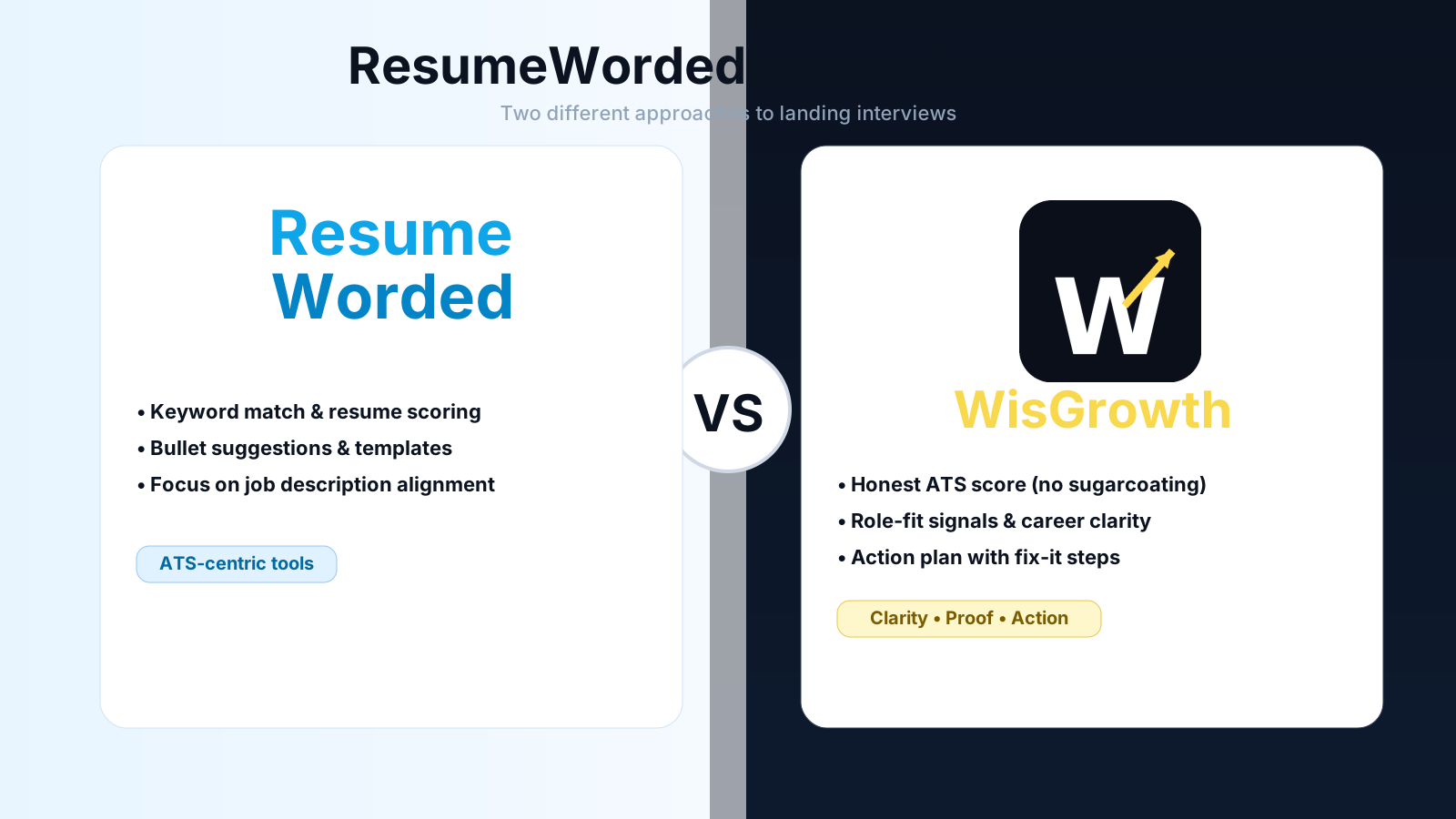
Resume Worded or WisGrowth?
Resume Worded gives line-by-line AI feedback on resume and LinkedIn wording, plus a numeric score meant to flag weak phrasing, passive language, and formatting issues. It's a fast way to tighten sentences and catch common writing mistakes before you send a resume out.
WisGrowth asks a different question: not just whether a sentence reads well, but whether it proves you can do a specific target role. That matters more now that ATS platforms lean on semantic, AI-based matching rather than literal phrase matching, so chasing exact wording buys less than real evidence does. A polished bullet with no proof behind it can still leave a hiring manager unconvinced.
Use Resume Worded when your main need is line-level writing feedback, clearer phrasing, stronger verbs, or LinkedIn polish. Use WisGrowth when you want to know whether the content itself proves you fit a target role. The two checks answer different questions, and using both in sequence is reasonable.
Why score-chasing stalls
Most scorecards optimize for keyword coverage and formatting heuristics. Useful, but incomplete. They rarely measure context relevance (do your bullets map to the role's real problems?), outcomes (what changed because of you?), or parser reliability across different systems. That gap explains why a glossy 95% can still yield zero interviews.
Good sentences and good evidence are not the same thing
AI feedback tools are good at spotting generic phrasing, missing metrics, or wording that could be sharper. What they can't always judge is whether the underlying claim is credible or relevant to a specific role; a well-written bullet about the wrong kind of work still won't land. Wording quality and evidence quality need separate checks, and it helps to know which one you're actually improving.
- A well-phrased bullet can still describe the wrong kind of work.
- Score inflation from wording fixes can mask a thin work history.
- Line-editing works best once the underlying content is right.
- Role fit depends on what you did, not only how you describe it.
WisGrowth vs scorecards (complement, don't compete)
- Clarity first: lock your role family so every edit increases relevance, not just score.
- ATS honesty: our Honest ATS baseline prioritizes parsing reliability over inflated numbers.
- Proof weekly: ship micro-work samples you can attach to applications and outreach.
- Calibrated pipeline: fewer, better applications-with clear evidence attached.
Where WisGrowth adds a proof and fit layer
WisGrowth's Resume Story Check looks at whether your resume, as a whole, supports the specific role you're targeting: which claims have visible proof, which feel unsupported, and what the single most useful next edit would be. It also checks ATS parsing separately from writing quality, since a beautifully worded resume that a parser mangles still underperforms in practice.
- Reads the resume against one named target role, not in general.
- Separates parsing and ATS readability from wording quality.
- Flags the one gap most worth fixing next.
- Complements wording feedback rather than duplicating it.
Turn any scorecard into action (30-minute workflow)
- Choose a single JD from your role family. Identify 3 recurring problems in the description.
- Map your bullets to those problems. If a bullet doesn't speak to them, rewrite or remove.
- Add one number (delta, rate, time, volume) per bullet to prove impact.
- Run honest ATS to catch parsing errors. Fix headings, dates, and risky layouts.
- Create a tiny work sample (one-pager or Loom) that demonstrates your approach to one problem.
Now your 0-100 score is a starting point-not the finish line.
From low-signal to outcomes
- Instead of: "Responsible for stakeholder communication."
Use: "Cut pilot sign-off time 34% by replacing weekly updates with a single Risks/Decisions doc." - Instead of: "Helped improve onboarding."
Use: "Reduced onboarding time from 21 → 15 days by shipping a checklist + 3-video walkthrough." - Instead of: "Worked with data team."
Use: "Increased lead-to-meeting rate 14% → 22% by adding routing rules; built a QA dashboard in Sheets."
Common traps (and antidotes)
- Chasing 100/100 → Stop at 'honest enough', invest in proof.
- Copying JD phrases → Translate to outcomes you've shipped.
- Over-formatting → Parser-safe structure (clean headings, consistent dates).
Your 3-week cadence (small, repeatable, sane)
- Week 1: Pick role family; run Check what story your resume tells; rewrite 3 bullets.
- Week 2: Ship one work sample (case note or 2-min Loom) tied to a role problem.
- Week 3: Apply to 6 aligned roles; attach work sample; send 3 short, specific notes.
Repeat. By week 4 you'll see better replies because your materials prove fit.
Compare & go deeper
Getting the most from resume feedback tools
- I've fixed obvious wording and formatting issues.
- I've checked whether my strongest claims have real evidence behind them.
- I know the specific role my resume is trying to prove I can do.
- I've tested how the final file parses, not just how it reads.
Less scoring. More showing.
Choose a lane, fix parsing, publish one tiny win a week, and send targeted applications that include proof. That's how you turn "almost there" into interviews.
Start my Resume Story CheckFAQs
Only partly. They check keywords and structure, not relevance, outcomes, or parser reliability across systems.
- We add realistic target roles, ATS honesty, and proof to make scores useful.
High scores without interviews usually mean missing context, weak outcomes, or parsing issues. Calibrate to a role family, add outcome-based bullets, and ensure parser-safe formatting.
Pick one target role family, rewrite 3 bullets using Problem → Action → Outcome, run an honest ATS baseline, then ship a 5-10 hour work sample you can link in applications.
Yes. Start free first read and run an honest ATS baseline in minutes.
- Upgrade if you want deeper guidance and practical prompts.
No, WisGrowth's free check focuses only on your resume against one target role: the story it tells, the proof behind it, and ATS readability. Resume Worded's LinkedIn features address a different part of your job-search presence entirely.
That's a reasonable sequence. Many people first tighten wording with an AI feedback tool, then separately check whether the underlying content actually proves fit for a specific target role before they start applying.
Sources and references
Sources checked 24 August 2026.