AI career advice is useful when you know its boundary
AI can organize thoughts quickly. Human guidance is often better at stakes, context, contradiction, and accountability. The stronger move is knowing which kind of help the decision needs.
What this page helps you decide
- Is this a drafting problem or a decision problem?
- Where could AI miss personal context?
- What evidence should I gather before committing?
AI career risk is easier to judge at the task level than from headlines. Use this page to see what to adapt, strengthen, or stop worrying about.
AI can tell you what's possible. A human can tell you what's wise. The smartest approach is not to pick sides - it's to let AI do the fast, structured work and let humans handle context, emotion, and strategy.
What to do next
- Run an AI pass for options and role families.
- Translate your current experience into ATS-safe bullets.
- Then get a human to sanity-check the direction, gaps, and market timing.
- Document the plan for 90 days.
- Use the Career Decision first read if you don't know your lane.
= Try this next week: Ask AI for 3 role options pick 1 ask a human which is realistic for your profile.
WisGrowth exists to connect clarity (AI) with proof (your work) and guidance (human). Not one or the other.
Below is a evidence-led comparison so you don't get conflicting answers from tools and people.
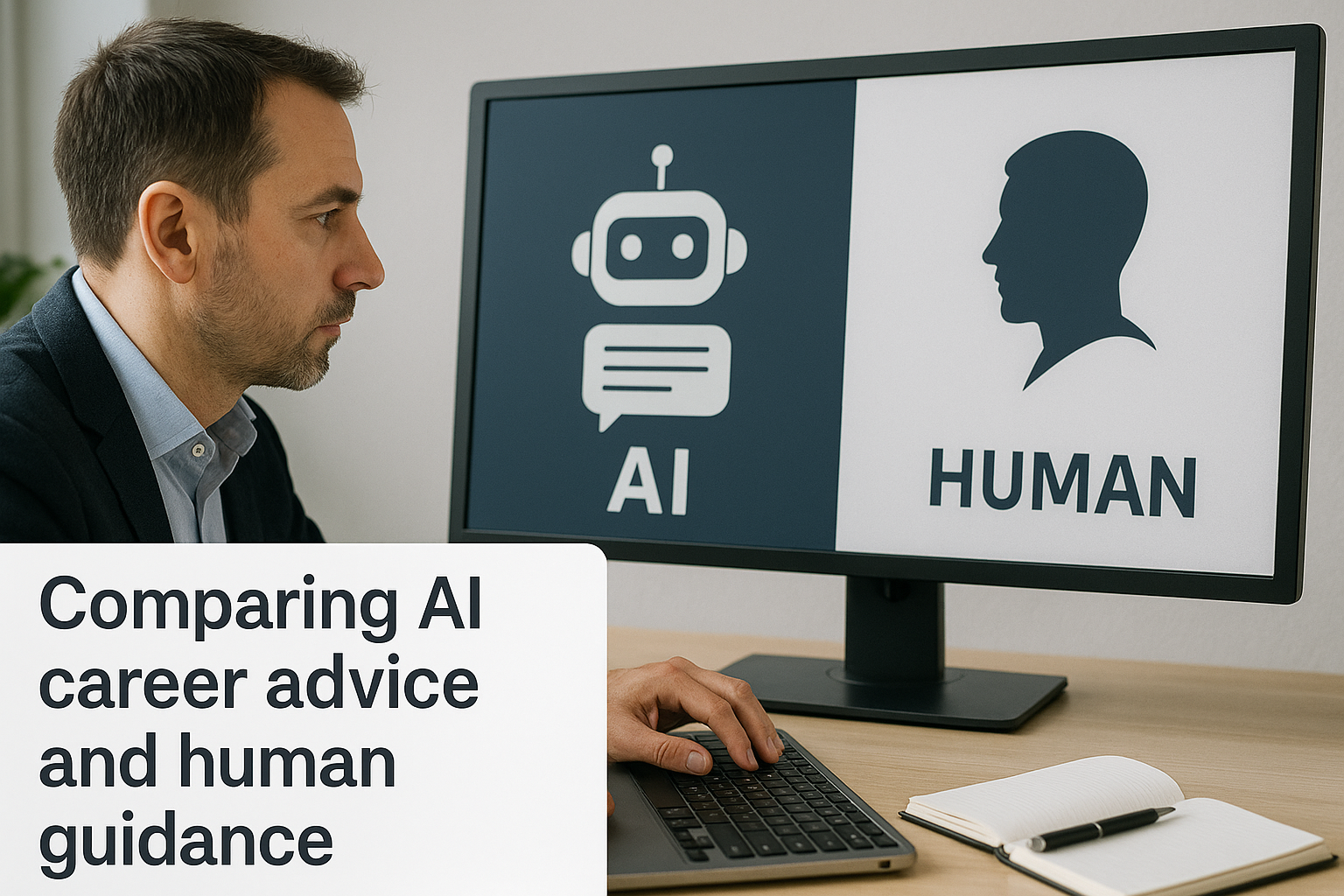
Where AI career advice is actually strong
AI is unbeatable at structured, repeatable, "tell me what's out there" questions. Use it for:
- Exploration: "Given I'm a PM in fintech with 8 years, what adjacent roles exist?"
- Translation: "Rewrite this bullet to show impact and scope."
- ATS alignment: "Match this resume to this JD and show missing skills."
- First drafts: outreach, summaries, career narratives.
- Pacing: checklists, weekly plans, skill stacks.
It's fast, non-judgmental, and available at 11 PM when you're anxious about work.
Where humans still win
Career decisions are rarely 100% logical. Humans add:
- Context: "You're in India aiming for remote US roles - here's what companies actually say vs what they post."
- Calibration: "That pivot is doable in 6 months, but not in 6 weeks."
- Priority: "Yes, data science is hot, but your fit signal says Ops/PM."
- Accountability: "You said you'd send 5-8 messages - did you?"
- Signal reading: "That was not a 'no', that was a 'follow up in 2 weeks'."
Humans are also better at **story repair** - especially if you have gaps, career breaks, or age-bias worries. An AI can rewrite your bio; a human can make sure it's believable.
The hybrid model (WisGrowth style)
This is how we recommend doing it:
- AI pass #1: clarity. Use AI to list 3-5 role families you can move into, plus skill gaps.
- AI pass #2: proof. Run your resume through the ATS-honest scanner and fix formatting, keywords, and vague bullets.
- Human pass: direction. Talk to a coach/mentor/manager to check realism: market, salary, timeline, geography.
- AI pass #3: execution. Let AI help you send outreach, write micro case studies, and track pipeline.
- Human pass: negotiation. Use a person for offers, org politics, and positioning.
AI speeds things up. Humans keep things aligned.
Common mistakes we see
- Letting AI overpromise: AI says "You can be a data scientist in 30 days." A human will tell you that's 6-9 months with portfolio.
- Using AI on the wrong question: "Should I leave my job?" is a values question, not a language question.
- Never showing your work: You fix your resume with AI but don't run it through an ATS baseline.
- Fragmented advice: You ask 5 different models and 0 real managers - now you're confused.
- Not disclosing constraints: AI can't guess you have caregiving, location, or comp constraints - so it gives generic advice.
Checklist: did I use AI and humans in the right order?
- [ ] I used AI to generate role/skill options.
- [ ] I ran my resume through an ATS-safe scanner (try this).
- [ ] I had a human review my direction or constraints.
- [ ] I saved AI outputs as proof-of-work (case studies, outreach drafts).
- [ ] I linked this to a 90-day plan (see 90-day career reset).
Related AI and career decision guides
When AI advice is useful but the stakes are high, connect it to role risk, validation, and human review.
FAQs
AI is great for fast options, resume rewrites, and role exploration. It's weaker on your personal constraints, market timing, and emotional decision-making - that's where a human helps.
When the stakes are high (offers, pivot after 40, career gaps, relocation, compensation negotiations) or when you need accountability.
WisGrowth gives AI-level speed for clarity and ATS translation, and points you to human guidance when your situation is complex, messy, or midlife-specific.
Where WisGrowth fits
Start with the Career Decision first read if you're still collecting options. Use the ATS-honest resume scanner to make sure AI-written text actually parses. Then, if you're midlife or doing a bigger change, read Midlife Career Coaching or WisGrowth vs Others to see how our guidance differs from generic AI tools.
Use AI for speed. Use humans for decisions.
Give yourself one week to try the hybrid flow - AI for drafts, human for direction. That's how careers actually move.
Start my Resume Story CheckSources and references
Sources checked 24 August 2026.
Grounded in real-world career data
WisGrowth references occupation, skill, education, and labour-market data from trusted public sources where available, then connects those signals to your current proof and next move.
- Looks at tasks, skills, proof, and adaptability instead of job-title panic.
- Keeps recommendations realistic, current, and evidence-aware.
- Shows when a signal is incomplete instead of pretending every answer is certain.