Career Experiments: Test a Career Before You Commit
Uncertainty isn't failure. It usually means you're being asked to make a high-stakes decision with low feedback. The problem isn't that people "choose the wrong career." The real problem is simpler: they choose without testing.
A calmer mental model
- Careers should be tested, not guessed.
- Small experiments create evidence faster than big commitments.
- Evidence reduces regret, improves resumes, and makes decisions feel lighter.
Try this: pick 2 roles you're curious about. Write the smallest "proof" you could ship in 7 days for each.
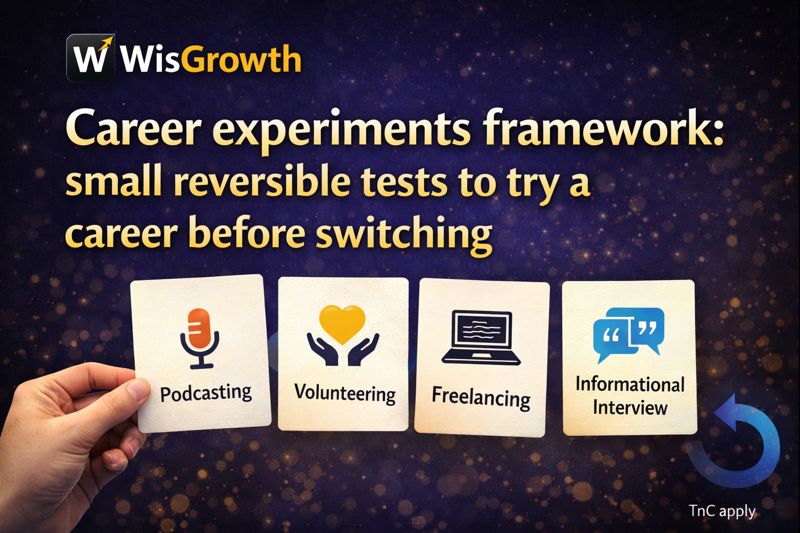
What is a career experiment?
A career experiment is a small, reversible, time-bound test that produces evidence about a career direction. It's how you answer: "Would I enjoy this work?" and "Can I do it well enough to get hired?" without betting your life on a guess.
- Small: fits into real life (even with a full-time job)
- Reversible: low downside if it's not a fit
- Time-bound: days or weeks, not years
- Evidence-producing: creates proof, not opinions
A course can teach skills. An experiment tells you if the career is worth pursuing.
Why traditional career decisions fail
Most career choices are made with commitment first and feedback later. That's backwards for modern careers, especially for switchers and cautious planners.
- Degrees: high commitment before you know the daily work
- Courses: skill accumulation without real context or proof
- Career quizzes: helpful for ideas, weak for validation
- One-time counselling: advice without lived evidence or iteration
The pattern is the same: big spend, low feedback. Career experiments flip it: small spend, fast feedback.
Common career experiment formats
Here are experiment formats that work in the real world (and create proof you can show):
1) Mini projects
Create a small work sample that resembles real work: a case study, a dashboard, a landing page critique, a short automation, a product teardown.
2) Role simulations
Simulate the job: respond to 10 support tickets, write a sales call plan, do a UX audit, build a 1-page strategy memo.
3) Skill sprints
Learn one job-relevant skill and ship one outcome. Not "finish a course"-ship something.
4) Market tests
Apply to 5 aligned roles, do outreach, ask for feedback, track responses. Markets don't lie.
A simple career experiment blueprint (the one most people skip)
If you do only one thing, do this: define the proof before you start. Proof turns your experiment into something valuable-even if you don't switch.
| Step | What you write | Why it matters |
|---|---|---|
| Hypothesis | "I might enjoy role X because&" | Forces clarity without pressure |
| Constraint | Time you can realistically commit | Prevents burnout and drop-off |
| Proof | One work sample you will ship | Creates career evidence |
| Feedback | Who will review it? | Turns work into signal |
| Decision rule | What "continue" looks like | Reduces overthinking |
Want a faster start? Use the Career Decision first read to pick a direction, then run a focused evidence test.
How WisGrowth enables career experiments
WisGrowth is built around one adult idea: direction + experimentation + proof. Not hype. Not "find your passion." Not random advice.
- Direction: choose what is worth testing (not 20 possibilities).
- Experiment: structured tasks that reflect real work.
- Proof: work samples that turn effort into signal.
- Reflection: what changed-energy, confidence, skill, market response?
You can pair this with your job search system: after each experiment, run an ATS compatibility check and update your resume with evidence-backed bullets.
What you gain (outcomes that reduce risk)
- Fewer regrets: decisions get lighter when they're evidence-based.
- Better resumes: proof makes your resume sharper than adjectives ever will.
- Clearer decisions: you stop collecting opinions and start collecting signal.
- Stronger confidence: confidence comes from shipping and feedback, not motivation.
Even "failed" experiments are valuable: they prevent expensive commitments in the wrong direction.
Who should use career experiments?
- Career switchers who want a safer move
- Burned-out professionals who feel "off" but can't explain why
- Overthinkers stuck between options
- High performers who want alignment without drama
Your current state your next safe move
This is the trust model in action: we don't push. We guide the next safe step.
- Exploring: test 1-2 directions with focused evidence tests start at Examine my career decision.
- Building: deepen proof where energy rises ship weekly work samples (see focused evidence test).
- Applying: align resume + ATS + outreach start with Resume Scanner and free ATS score checker.
Deep links (use this as your experiment hub)
Start with one safe career experiment
You don't need a five-year plan. You need one well-designed test, then one work sample.
Get a free first readFAQs
A career experiment is a small, reversible, time-bound test that helps you evaluate a career direction using evidence instead of assumptions. The output is not a feeling. It's proof: a mini project, a role simulation, a short portfolio work sample, or a market test that shows what the work is actually like and whether you can sustain it.
Most career experiments take 7-30 days. The ideal duration is long enough to produce one real work sample (proof) but short enough to stay low-risk.
- If you're working full-time, aim for 3-5 hours per week and a single deliverable by the end (a case study, a mini build, or a structured analysis).
Yes-career experiments are designed for real life. The key is making the experiment small and time-bound: one weeknight block, one weekend block, and a Friday shipping ritual.
- You're not trying to master the career in 14 days. You're trying to gather enough evidence to make a safer decision.
Courses build knowledge. Experiments build evidence.
- If you're unsure about direction, experimentation usually comes first: test the work, then invest in learning.
- When you've validated a direction, a course becomes a smart accelerator, not an expensive guess.
A failed experiment is still a win because it prevents a larger failure later. If you learn 'I don't enjoy this work' or 'this role drains me,' you just saved months (or years) of wrong commitment.
- Good experiments are designed to be reversible: small cost, high learning.
Sources and references
Sources checked 24 August 2026.
Clear next step
- Use the page to name the decision, not just collect more advice.
- Look for the missing evidence that would make the next move safer.
- Take one small action now, then review what changed.
Built on more than a quiz
WisGrowth studies where you are now, where you want to go, what proof you already have, and what evidence is missing before suggesting a next move.
- Combines decision context, strengths, skills, interests, constraints, and missing evidence.
- Uses career-stage patterns and real-world occupation or skill data where available.
- Helps you decide what to test, what to build, and what to avoid rushing into.