ATS Resume Explained (2026)
ATS systems are not trying to reject you. They are simply following rules.
Updated for 2026 · Practical guide for US and EU job seekers applying globally · No fear, no gimmicks.
Quick check: If your resume cannot be read cleanly when you copy paste it into a plain text editor, ATS may struggle too.
Start free first read → How to Find the Right Career
What ATS actually does
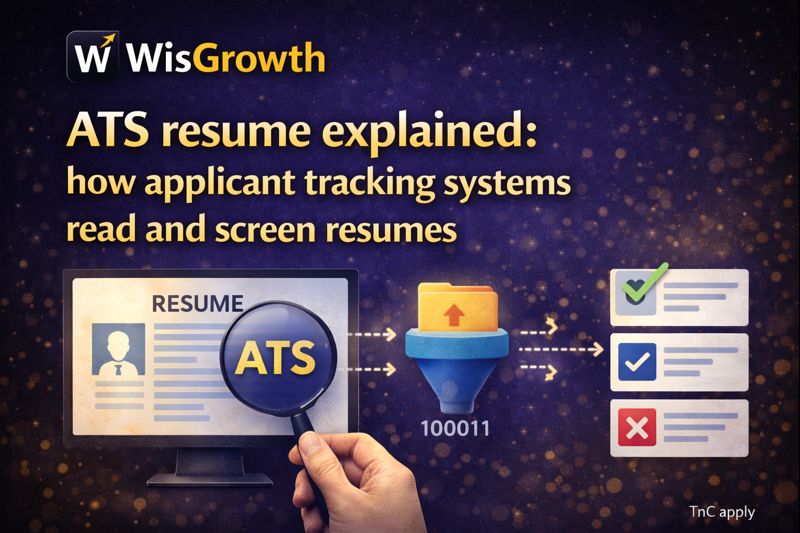
ATS stands for Applicant Tracking System. Companies use it to collect applications, store resumes, and help recruiters search and filter candidates. It is less like a judge and more like a filing system with rules.
Most ATS systems do a few simple things
- Parse your resume into fields like name, contact, work history, education, skills
- Index your content so recruiters can search for role related terms
- Match basics like job title alignment, required skills, location, experience ranges
- Help humans shortlist by ranking or filtering in a dashboard
ATS does not understand your potential. It reads your document and tries to classify it. Clarity matters more than cleverness.
Common ATS myths that create unnecessary fear
Myth 1: ATS only cares about keywords
Keywords help, but only as a part of alignment. If your resume mentions the right terms but your experience does not support them, it still reads weak. A better way to think about it: ATS helps surface your resume to a recruiter. The recruiter decides if you make sense.
Myth 2: Fancy formatting is always rejected
The real issue is not beauty. It is parse reliability. Two column layouts, text boxes, icons, and complex tables can confuse parsers. A clean structure with standard headings is not boring. It is functional.
Myth 3: You need a perfect score
Many "ATS scores" on the internet are simplified. Real systems vary by company and workflow. Chasing a score can turn your resume into a keyword soup. The goal is not a score. The goal is a clear match.
If you want to understand how keywords work in ATS, start with the Resume Keyword Scanner guide or the ATS resume checker guide. For an actual score, use the Check what story your resume tells. Then fix what matters.
Check your resume ATS score ATS resume template and ATS checker guide
What ATS really looks for
This is what makes a resume pass both software and human review. It is less about hacks and more about signal. Pair that with the How to Find the Right Career so your resume reflects a real target role instead of a generic profile.
Role alignment
Your recent titles, core responsibilities, and keywords should point to the role you are applying for. If your resume looks like three different careers, it becomes harder to place.
Signal clarity
Recruiters skim fast. ATS helps them filter fast. Your bullets should communicate outcomes. "Did X, improved Y, by doing Z" beats long paragraphs.
Proof
Proof is what makes your claims believable. Projects, shipped work, metrics, case studies, impact. Proof also helps when you are switching domains.
Consistency
Standard headings, consistent dates, readable job titles, predictable structure. It makes parsing easier and makes humans trust what they are reading.
If you are changing careers, your proof becomes even more important. That is why we push career experiments as the foundation. See Career Experiments.
How WisGrowth approaches ATS
We look at your resume the same way a recruiter would: as proof of what you've actually done.. The goal is to make your story easy to understand and hard to dismiss.
A practical way to approach ATS
- Proof: you build evidence you can point to
- Alignment: you map proof to target role requirements
- Clarity: you rewrite bullets so both ATS and humans can read the match fast
If you want to start with a real JD, begin with Resume Keyword Scanner. If you want to start from direction, begin with Check what story your resume tells.
Applying globally? Use ATS Compatibility Test and Free ATS Resume Score Checker to set a baseline before you rewrite everything.
When to optimize your resume vs rethink direction
This is the part most people skip. It matters because it saves you months.
| If you are seeing this | Do this next |
|---|---|
| You get interviews sometimes, but not consistently | Optimize clarity and alignment. Tighten titles, bullets, and role language. |
| You get almost no callbacks across many applications | Check direction and match. Your resume may be describing a different role than you are applying to. |
| You are switching careers with limited proof | Do one focused evidence test and ship proof. Then update the resume. Start with Career Experiments. |
| Your resume is strong, but offers are not coming | Look at market signals and targeting. Role selection and outreach matter as much as formatting. |
If you are trying to switch without quitting, use the parallel model. See Career Change Without Quitting Your Job.
Related links you can use right now
Want a fast, calm baseline first?
Match your resume to a real job description, then improve only what matters.
Run Resume Keyword ScanFor parsing + formatting issues, run the ATS Compatibility Test.
What to do next
1. Open the ATS resume template and simplify any formatting that blocks parsing.
2. Use the How to Find the Right Career to align your resume with one clear role family.
3. Check what story your resume tells before you send the next application.
About the author
Author: WisGrowth / Amit Aggarwal
FAQs
An ATS resume is a resume written so an Applicant Tracking System can reliably parse it and match it to a job description. It's not magic keywords - it's clear structure, standard headings, and role-aligned language so both software and humans can understand your fit.
Many mid-size and large companies use some form of ATS, especially in the US and EU. Smaller companies may still use ATS via job boards or lightweight portals.
- Even without ATS, recruiters skim quickly, so clarity and alignment still matter.
Yes. Good candidates can be filtered out if a resume is hard to parse, missing key role signals, or looks misaligned.
- That doesn't mean you're weak - it means the document didn't communicate fit clearly enough for an automated first pass.
Not always. Optimization helps when your direction is correct and the resume is simply unclear.
- But if you're applying to roles that don't match your evidence, you may need proof, repositioning, or clearer direction - not just formatting and keywords.
Sources and references
Sources checked 24 August 2026.
Your resume is more than a document
WisGrowth uses resume signals to understand what your experience currently proves, what it does not prove yet, and which paths may need stronger evidence before you commit.
- Checks parser readability, role keywords, recruiter clarity, and missing evidence.
- Connects resume evidence to the role or move you are considering.
- Gives decision support, not a guarantee of interviews, hiring, salary, or employer outcomes.