Run a 90-Day Career Reset - A Playbook You Can Actually Finish
Thinking about a change is not the hard part. The hard part is knowing whether this move is strong enough to act on.
Burnout isn't a personality flaw - it's a design problem. If work has started crowding out life, this 13-week plan helps you redesign your week, regain momentum, and move toward a career that fits your reality. This is an informational guide you can follow with or without WisGrowth.
What to do next (simple start)
- Protect your non-negotiables: sleep, health, family, recovery time.
- Name 3 energisers + 3 drainers from last week. Adjust your week around them.
- Choose one direction to test for 90 days (not forever).
- Ship one small work sample weekly (one page / 3-5 minutes).
- Rewrite your story: "What I'm moving toward" in 3 sentences.
= Try this next week: rewrite one resume bullet with an action verb + measurable outcome.
If you want help with structure, you can use WisGrowth tools alongside this plan: Examine my career decision and Resume Scanner.
A 13-week program to go from confusion to momentum. Weekly objectives, scripts, and checkpoints you can follow.
Start free first read → How to Find the Right Career
What this reset is, and isn't
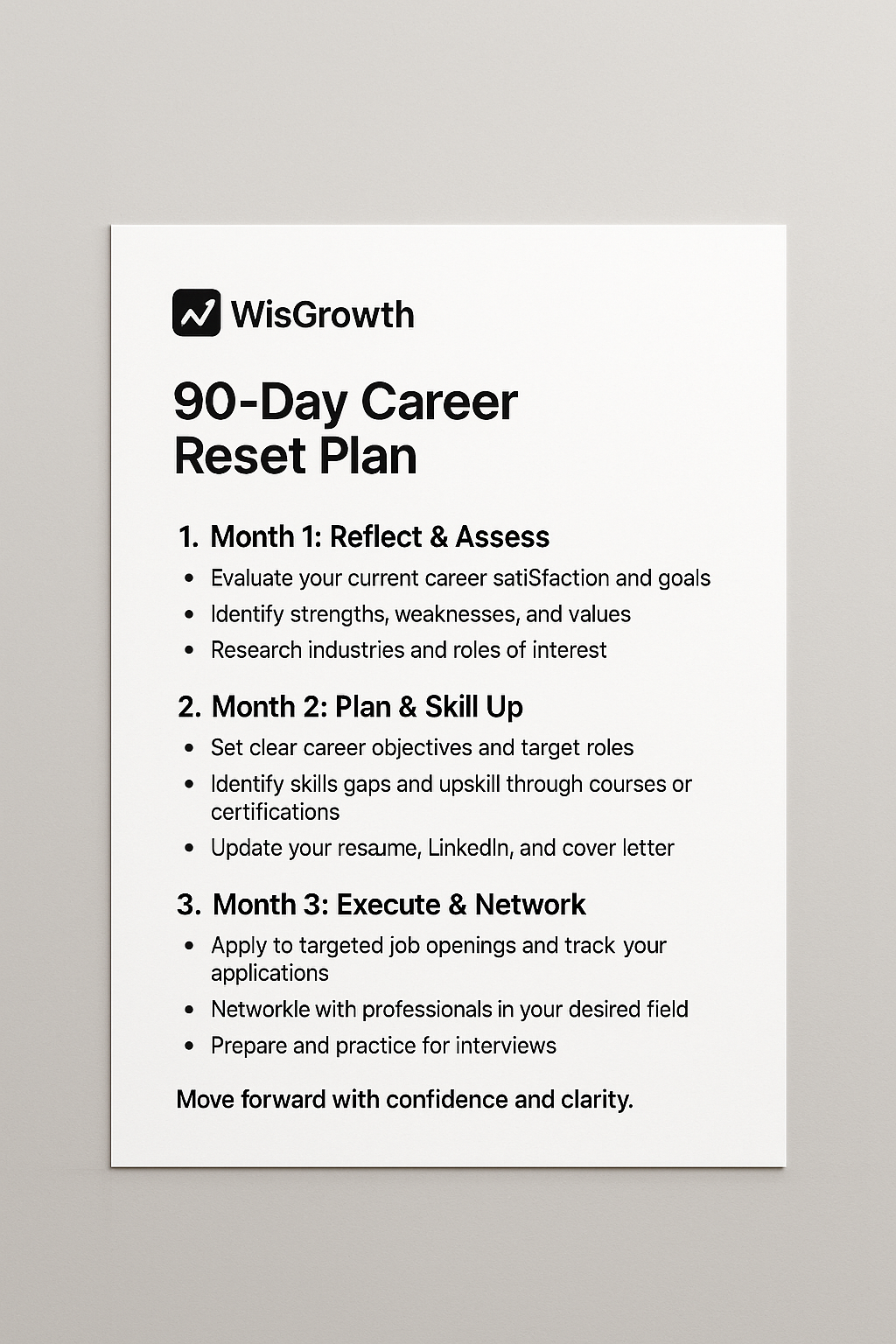
This plan is for people with real constraints: a demanding job, family responsibilities, and limited time. It's not "quit and reinvent yourself" advice. It's a compact operating system you can run alongside life: pick one direction, upgrade one decisive skill, ship visible proof, and build a pipeline of conversations.
The goal isn't to change everything at once. It's to create measured momentum that compounds. When in doubt: narrow the scope, finish the smallest useful version, and move to the next step. If you need a clearer starting point, use the How to Find the Right Career to keep your reset focused instead of reactive.
Weeks 1-3: Clarity
Choose a target direction you can commit to for 90 days. You're not picking a forever identity- you're making a useful bet you can test. Do a fast personal audit:
- Energizers vs. Drainers: List five tasks that give energy and five that drain it.
- Constraints: Time, money, location, caregiving-write them down so your plan fits real life.
- Target problems: Identify three problems you enjoy solving that employers pay for.
End this phase with a one-page plan: target role family, one skill to upgrade, two proof ideas, and a weekly time budget. If you need a structured starting point, try the Career Decision first read (they're designed to surface strengths you under-value). Or explore our How to Find the Right Career for deeper insights.
Find your next step now Examine my career decision
Weeks 4-7: Capability
Pick one decisive skill (maximum two). Rule: if you can't demonstrate it in a short work sample, it's too broad. Examples: "SQL dashboards", "Landing page CRO", "Stakeholder mapping", "User research synthesis".
- 45-minute practice blocks, 4 per week: one course + two real examples.
- Shadow and copy: rebuild a small public Career Experiment Ideas before inventing your own.
- Feedback loop: ask one peer for one improvement, then apply it.
By week 7 you should have one tangible work sample you can show-clean, simple, and relevant. Not perfect, but publishable. This is also the right time to borrow from our career experiment ideas so your practical evidence stays small enough to finish.
Weeks 8-10: Proof
Now you turn capability into evidence. Ship two micro case studies and one public demo. Keep them short enough for someone to skim.
- Case Study #1 (Work-adjacent): improve something by 10-20% and document baseline change result.
- Case Study #2 (Volunteer/friend/business): a tiny, time-boxed improvement you can describe honestly.
- Public Demo: a 3-5 minute walkthrough (Loom or simple page) that shows what you did.
Add metrics and a "what I'd do next" section. This is what hiring managers actually scan for.
Weeks 11-13: Pipeline
Proof is useless if nobody sees it. Now you turn proof into conversations. Skip mass applications-aim for calibrated outreach:
- Shortlist 25 targets: companies/leaders where your proof is relevant.
- Script: "I saw you're working on X. I built Y that improved Z by 18%. Want the 3-minute summary?"
- Volume: 5-8 genuine messages per week, 2 follow-ups spaced a week apart.
Track weekly: replies, conversations, interviews. Expect a lag-week 12 is often where momentum appears.
Your weekly scorecard (keep it simple)
| Metric | Target | Why it matters |
|---|---|---|
| Focused practice blocks | 4 45 min | Skill gains compound with short, specific reps. |
| Shipped work samples | 1 mini-work sample / week | Visible output beats "learning" in private. |
| Meaningful outreach | 5-8 msgs + follow-ups | Quality conversations create options. |
| Reflection | 15 min Sunday | Decide next week's smallest useful step. |
Common traps, and how to avoid them
- Too many goals: Pick one bet and one skill. Park the rest for 90 days.
- Course collecting: Learn the minimum, then ship something tiny. Feedback is the teacher.
- Silent job boards: Calibrate early-ask about scope and success criteria in conversations.
- Identity panic: You're not "starting over". You're translating past wins into a new container.
If you want tools alongside this plan (optional)
This guide works on its own. If you want structured tools while executing:
- Examine my career decision - helps you pick a direction you can commit to for 90 days.
- Resume Scanner - checks ATS parsing and clarity (baseline format + role signal).
- Career Coaching - if you want accountability and feedback.
What to do next
1. Protect your non-negotiables and identify energizers vs drainers.
2. Choose one direction to test for 90 days.
3. Ship one small work sample this week.
Get started with our How to Find the Right Career.
Kick off your reset this week
One focused hour a day is enough to change your trajectory this quarter. Keep the scope tiny, ship weekly, and let proof do the talking.
Start my Career DecisionAbout the author
Author: WisGrowth / Amit Aggarwal
FAQs
Pick one role family, ship one small work sample weekly, rewrite three resume bullets with measurable outcomes, and start 5-8 quality conversations per week.
- Don't over-plan-finish small steps consistently.
Lead with outcomes and scope, show recent proof-of-work, and craft a simple bridge story for the gap (what you did, what you learned, how it helps the target role).
- Proof reduces assumptions.
Yes. Start with a free first read and run a resume scan to remove formatting issues and clarify role signal before you apply.
Sources and references
Sources checked 24 August 2026.
Built on more than a quiz
WisGrowth studies where you are now, where you want to go, what proof you already have, and what evidence is missing before suggesting a next move.
- Combines decision context, strengths, skills, interests, constraints, and missing evidence.
- Uses career-stage patterns and real-world occupation or skill data where available.
- Helps you decide what to test, what to build, and what to avoid rushing into.