Free resume checker Australia
Free resume checker for Australian job applications
Upload your resume or CV and check whether it is clear, keyword matched, and ready for Australian employers, graduate roles, casual work, and professional applications.
Built for Australian job applications
- Works with resume and CV wording used in Australia.
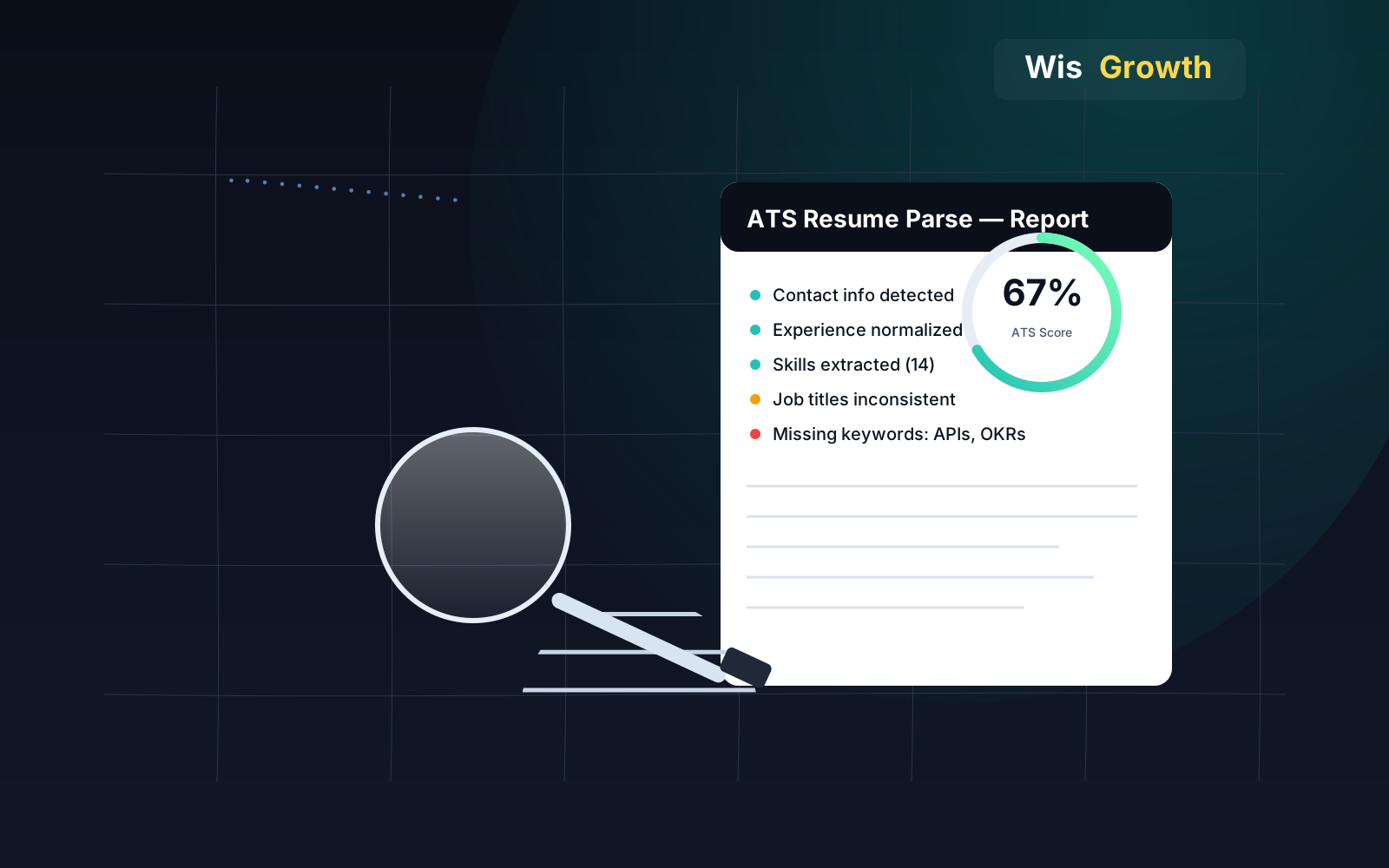
- Checks clarity, keywords, structure, and ATS readability.
- Helps with SEEK, LinkedIn, and company career page applications.
- Useful for graduates, career changers, and professionals.
- Gives practical fixes without rewriting your experience into generic text.
What your free check includes
- ATS readability.
- Keyword match.
- Experience clarity.
- Formatting issues.
- Missing proof points.
- Suggested next steps.
Use the check before applying on SEEK, LinkedIn, or a company career page. It is a practical review, not a promise of interviews.
Who this helps
- Students applying for graduate roles.
- People applying on SEEK or LinkedIn.
- Professionals changing roles.
- International candidates preparing an Australian style resume.
Australian resume signals that matter
Australian applications often expect direct proof, simple layout, and a tailored resume and cover letter unless the job ad says otherwise.
- Use Australian spelling consistently, such as organisation, centre, licence, and optimise.
- For casual work, show availability, customer handling, reliability, licences, and location fit where relevant.
- For graduate roles, include projects, internships, placements, volunteering, and measurable leadership.
- Keep the layout simple and professional so employers can scan it quickly.
Length, photo, and referee conventions
Australian resumes are generally longer than the tight one-page US standard, and two to three pages is common once you have several years of experience. A photo is not expected and is often left out. Referee handling varies: some applicants list two referees directly, others simply note availability on request.
- Allow roughly two to three pages for an experienced applicant, one for early career.
- Leave out a photograph unless the specific role or industry expects one.
- List two referees with contact details, or state they are available on request.
- Use Australian spelling such as organise, colour, and programme.
Addressing selection criteria when required
Government roles and some larger organisations ask applicants to respond to separate selection criteria, describing how their experience meets each stated requirement. Even where early screening is automated, selection-criteria responses are usually read closely by a human panel later on, reflecting a broader shift toward more human verification at later hiring stages. Treating this as a formality rather than a serious writing task is a common reason otherwise well-qualified applicants are screened out early in an otherwise competitive hiring process.
- Address each criterion individually with a specific example, not a general statement.
- Use a clear structure such as the situation, your action, and the result.
- Keep each response focused and avoid repeating your full resume content.
- Match the language of the criteria closely, since assessors often check for it directly.
Fix order before the next application batch
- Read the job ad and mark the real keywords.
- Check that the resume parses cleanly.
- Tailor the summary, skills, and top bullets to that role.
- Add proof for licences, availability, projects, or outcomes where relevant.
- Use the cover letter to explain fit and motivation briefly.
FAQs
Common questions before checking a resume or CV for Australian job applications.
Both terms are used in Australia. Resume is common for many job applications, while CV may appear in some ads, sectors, and professional contexts. WisGrowth supports resume or CV wording for Australian applications.
Yes. You can check your resume before applying on SEEK, LinkedIn, or a company career page so you can improve readability, keywords, structure, and proof points first.
Yes. The free check reviews ATS readability signals such as headings, formatting, selectable text, dates, keywords, and whether the document is easy to scan.
Yes. Students and graduates can use it to check whether projects, placements, internships, volunteering, part-time work, and education show relevant evidence for graduate roles.
For most Australian job applications, focus on contact details, skills, experience, education, and proof. A photo is usually not needed unless the employer specifically requests one.
No. The checker reviews your resume or CV and suggests practical next steps. You stay in control of your wording and experience.
Yes. You can start the free resume check without changing scanner functionality or paying first.
Roughly two to three pages for experienced applicants is common, longer than the tight one-page US norm. Early-career applicants can generally keep it shorter, around one to two pages depending on experience.
Either approach is accepted: listing two referees with contact details, or simply stating they are available on request. Choose one approach and confirm your referees are prepared to be contacted beforehand.
Country selector
Applying outside Australia? Choose the checker that matches the local resume or CV format.
Not sure this is the right role?
Before rewriting your resume around one target, check whether the direction itself fits. The free Career Decision first read shows fit, risk, missing evidence, and a focused evidence test.
Your resume is more than a document
WisGrowth uses resume signals to understand what your experience currently proves, what it does not prove yet, and which paths may need stronger evidence before you commit.
- Checks parser readability, role keywords, recruiter clarity, and missing evidence.
- Connects resume evidence to the role or move you are considering.
- Gives decision support, not a guarantee of interviews, hiring, salary, or employer outcomes.