Career Clarity vs Career Counseling - Which One Do You Actually Need?
Not all career help is the same. Sometimes you need a human to answer one tough question. Sometimes you need a system to help you move every week. This page shows the difference - and when WisGrowth is the better fit.
What to do next
- Identify your current problem: "I don't know what I want" vs "I know, but I can't get there."
- Pick your mode: clarity process (ongoing) or counseling session (one-off).
- Run the Career Decision first read to surface drivers and constraints.
- Translate insights into resume/proof using the honest ATS scanner.
- Bookmark this page - clarity is iterative.
WisGrowth exists so careers stop being a guessing game - you get calm direction and practical next steps.
Let's compare them side by side so you stop buying the wrong solution.
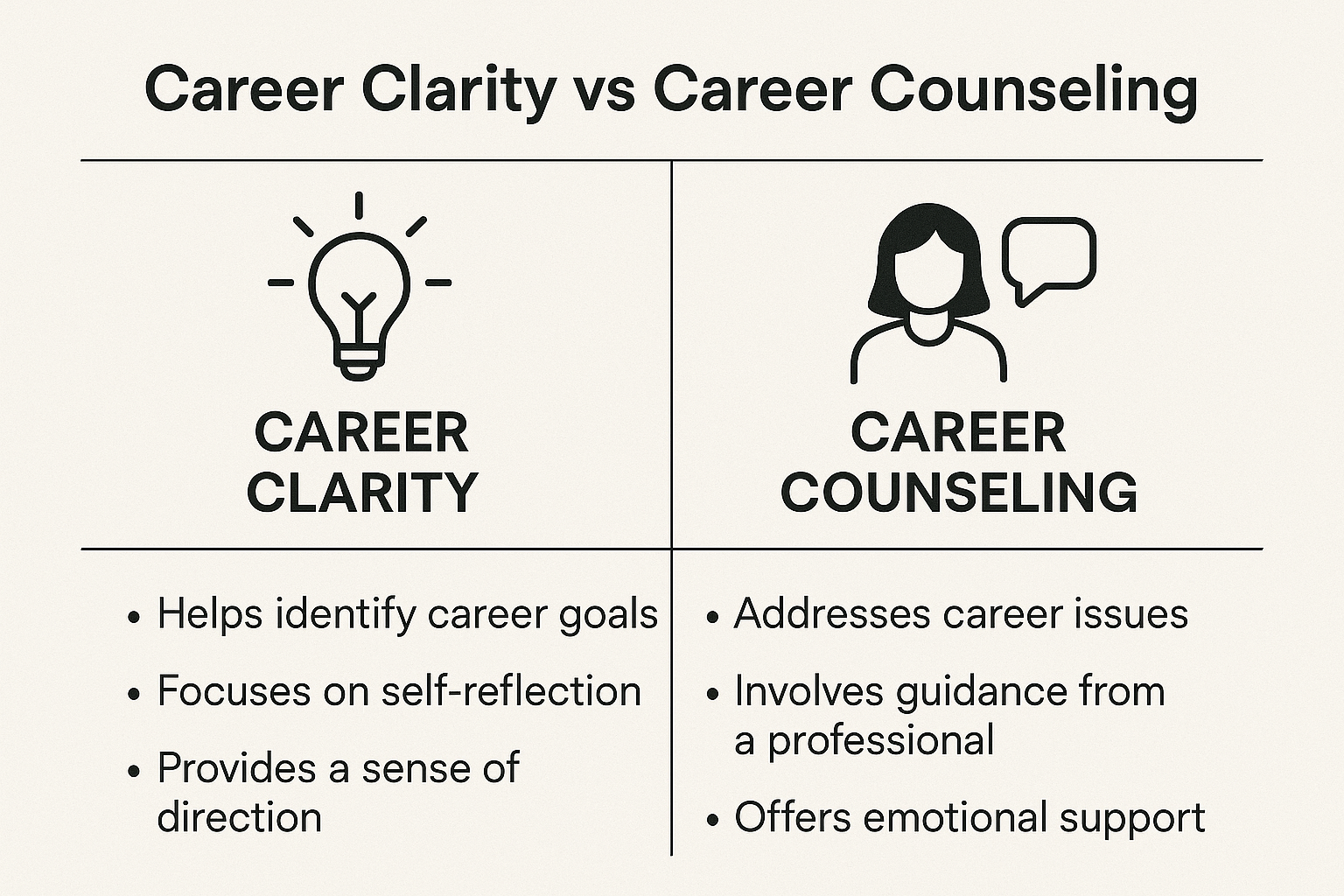
What is "career clarity"?
Career clarity is an inside-out process. You map your energy, strengths, values, constraints, and market reality - then design work that actually fits. It's less "What job is trending?" and more "What work matches the way I'm built, in this season?"
In WisGrowth terms, clarity = Name the decision → See the risk → Take one proof step → Decide with confidence. You keep looping through it as your life changes.
What is "career counseling"?
Career counseling is typically event-based. You meet a counselor when you need to choose a stream, switch industries, or interpret an assessment. You get recommendations, sometimes a report, and then you go execute on your own.
It's useful when your question is narrow: "Should I do HR or Marketing?", "Is this course worth it?", "How do I explain a gap?"
Key difference in outcomes
- Clarity: You leave with direction + 2-3 next steps you can repeat weekly.
- Counseling: You leave with advice + information, but you still have to build momentum.
That's why so many midcareer professionals collect reports but don't move - they got answers, not a system.
When to choose career clarity (WisGrowth-style)
Pick clarity if you recognise yourself here:
- "I've done a lot... but I can't tell a coherent story."
- "I want work that fits my life now, not 10 years ago."
- "I'm pivoting - I need proof, not just advice."
- "I want to test directions in 30-90 day cycles."
Start with the Career Decision first read → load those insights into your resume scanner → apply to roles that match the story.
When counseling is enough
Go for a counselor if:
- you just need to pick a course or certification,
- you need local admission/employment guidance,
- you want to understand psychometric results,
- you're a student/early-career and options are still wide.
You can still use WisGrowth after that to turn those decisions into documents, proof, and practical next steps.
Common mistakes people make
- Buying counseling when the problem is identity. If you don't know what work energises you, one session won't fix it - do clarity first.
- Skipping proof. Even if you know your direction, employers want examples. Use focused evidence test to create 1-2 work samples.
- Optimising resume too early. Don't rewrite your CV 10 times - first decide the lane, then run it through the ATS compatibility test.
Four decision factors that actually settle it
Most people pick based on which option they've heard of, not which one fits their situation. Run your situation through these four factors instead.
- Budget: A single counseling session usually costs less upfront than an ongoing paid process, but it's a one-time spend for a one-time answer. If money is tight and your real problem is "I have no direction at all," start with free self-work (the clarity questions list and the free first read) before paying anyone.
- Urgency: A hard deadline - a course application, an offer you must answer, a visa or notice-period clock - favors a single focused counseling session where someone with domain knowledge can give you a direct answer fast. An open-ended "I don't love my work" feeling has no deadline forcing it, so a slower evidence-building process fits better.
- Complexity: A narrow, factual question ("Is this certification worth it?" "How do I explain a resume gap?") is what counseling is built for. A tangled question that mixes identity, values, family pressure, and multiple live options rarely resolves in one session - it needs the iterative clarity loop instead.
- Accountability: If you know what to do but don't follow through on your own, the missing piece isn't more advice - it's a structure that checks in on you. Some counselors offer this; a self-directed clarity process only works if you actually run the weekly loop yourself.
Common pattern: people with a narrow, urgent, low-complexity question do well with counseling alone. People with a broad, low-urgency, high-complexity, low-accountability situation tend to stall with counseling alone because one conversation can't carry that much weight - they need the ongoing loop.
Checklist: Which one do I need right now?
- Do I know what I want? → No → start with clarity.
- Do I know what I want but can't position it? → clarity + ATS scan.
- Do I only have one narrow question? → counseling.
- Am I midlife / pivoting / returning after a break? → clarity + proof.
FAQs
Career clarity is an ongoing process of defining the work that fits your strengths, energy, constraints, and season of life - and translating it into next-step actions.
Career counseling is typically a one-time or short-term session with a practitioner who helps you interpret assessments, explore options, or navigate a specific decision.
Pick clarity when your problem is directionless momentum: you don't know what to move toward, how to sequence skills, or how to tell your story.
Ready to get clarity without overthinking?
Take the quiz, get a direction, then turn it into proof and ATS-friendly documents.
Compare my career decisionSources and references
Sources checked 24 August 2026.
Built on more than a quiz
WisGrowth studies where you are now, where you want to go, what proof you already have, and what evidence is missing before suggesting a next move.
- Combines decision context, strengths, skills, interests, constraints, and missing evidence.
- Uses career-stage patterns and real-world occupation or skill data where available.
- Helps you decide what to test, what to build, and what to avoid rushing into.