Why You Feel Stressed Even in a Good Job
You have a decent salary. A respectable company. Maybe even a role people would call “good.” But inside, you still feel tense, flat, or quietly restless. That feeling matters.
What matters here
Not all work stress means you are weak, ungrateful, or simply “bad at handling pressure.” Sometimes stress is a signal that your role, pace, environment, values, or growth path no longer fit who you are becoming.
During Stress Awareness Month, most advice focuses on calming stress. That matters. But career stress also needs decoding.
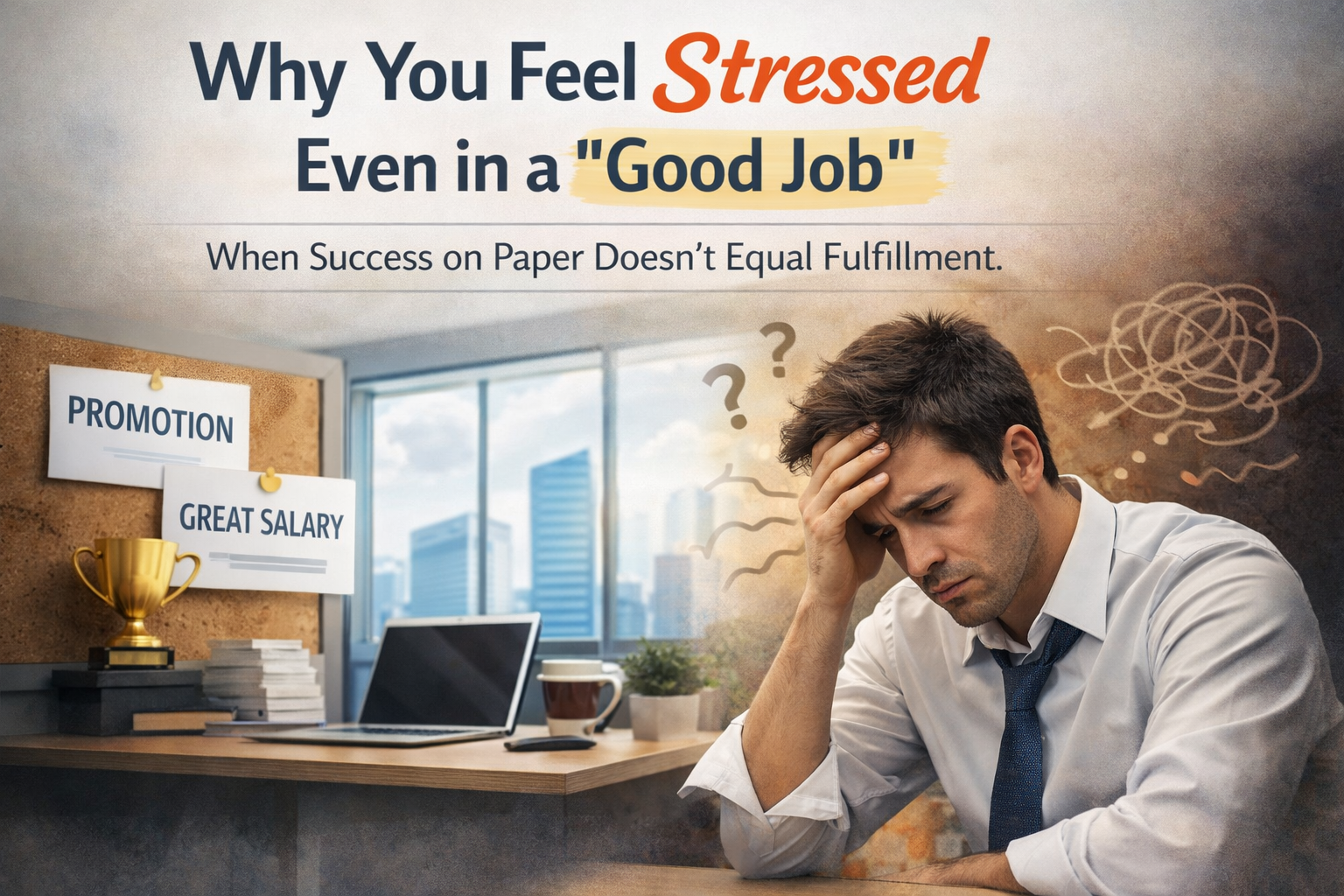
Stress Awareness Month is the perfect time to ask a better question
A lot of people search for terms like “stress awareness month,” “stress at work,” “why am I stressed in a good job,” and “burnout symptoms” when they already feel something is off. The problem is that most content stops at coping tips.
Coping matters. But if your stress keeps returning in the same situations, it may not be just a productivity issue. It may be a career pattern.
Sometimes the real problem is not that your job is hard. It is that your career no longer fits.
That is why this page is not just about stress management. It is about understanding what your work stress may actually be trying to tell you.
Why a good job can still create stress
This is where many people get confused. They look at the external markers and think: “I should be happy. Other people would want this job. Why do I still feel stressed?”
The answer is simple: external success and internal fit are not the same thing.
- You can be competent in a role that drains you.
- You can be well paid in work that no longer feels meaningful.
- You can be appreciated in a team where your natural style does not belong.
- You can be stable on paper but stagnant underneath.
That kind of stress is easy to dismiss because nothing looks obviously broken. There is no dramatic event. No clear crisis. Just a slow build of tension, resistance, overthinking, and emotional fatigue.
3 types of career stress most people miss
1. Misalignment stress
You are doing work that clashes with your strengths, values, or natural rhythm. You can still perform well, but it costs too much energy to keep doing it.
2. Stagnation stress
The role is not terrible. It is just no longer moving you forward. Your mind starts reacting because growth has quietly stopped.
3. Meaning-gap stress
You can do the job, but it does not feel connected to who you want to become. Over time, this creates flatness, disengagement, and inner friction.
This is the kind of framework that turns vague stress into something visible. And once you can name the pattern, you can respond better.
Burnout vs wrong career: do not confuse these
One of the biggest mistakes people make during periods of work stress is solving the wrong problem. They assume they are burned out when they may actually be misaligned. Or they assume they need a dramatic career change when what they really need is recovery from overload.
| Burnout / overload | Career misalignment |
|---|---|
| Usually tied to pace, pressure, or lack of recovery | Usually tied to role fit, values, identity, or direction |
| Time off may help noticeably | Time off may create relief, but the same discomfort returns |
| You may still care deeply about the work | You often feel emotionally disconnected from the work itself |
| The problem is “too much” | The problem is often “not right” |
You do not need to diagnose your whole life in one day. But this distinction is important. It helps you avoid shallow fixes and panic decisions.
A simple 3-day stress awareness exercise
Before making any major move, spend three days observing your work more carefully. Not judging. Not overthinking. Just noticing.
- Which tasks drain you fastest?
- Which conversations leave you tense or smaller?
- Which moments give you energy, curiosity, or relief?
- Do you feel stressed because of workload, or because of the kind of work itself?
This is where better career decisions begin. Not with random quitting. Not with generic motivation. With pattern recognition.
If you want a stronger next step, pair that reflection with your Career Decision first read, explore small career experiments, or run an honest ATS baseline if job-search stress is part of the picture.
What to do next if this feels familiar
You do not need to fix your whole career this week. You need one honest next move.
- Reduce the noise and name the actual stress pattern.
- Stop treating every stress signal as weakness.
- Test small, low-risk changes before making a big leap.
- Build evidence about what fits you better.
Stress Awareness Month should not only remind people to manage stress. It should also remind them to listen to it.
Because sometimes stress is not telling you to push harder. Sometimes it is telling you to realign.
Feeling this right now?
Do not just read about stress. Decode what your career stress may be signalling, then take a calmer and smarter next step.
Good for people feeling stuck, burned out, restless, or uncertain even in a “good” job.
FAQs
Can you feel stressed even if your job looks good on paper?
Yes. A good salary, strong brand name, or stable role does not guarantee alignment. Stress can come from mismatch, stagnation, or a lack of meaning.
Is this burnout or the wrong career?
Burnout often improves with recovery and boundary changes. Misalignment tends to keep returning because the deeper issue is fit, not just fatigue.
Should I quit immediately if I feel this way?
Usually not. Start by decoding the pattern, testing low-risk changes, and gathering proof about what fits better. Cleaner decisions come from evidence, not panic.
Related reading
Built on more than a quiz
WisGrowth studies where you are now, where you want to go, what proof you already have, and what evidence is missing before suggesting a next move.
- Combines decision context, strengths, skills, interests, constraints, and missing evidence.
- Uses career-stage patterns and real-world occupation or skill data where available.
- Helps you decide what to test, what to build, and what to avoid rushing into.